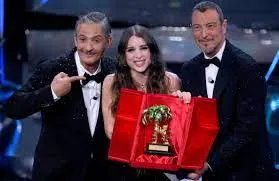
Image Credit — https://commons.wikimedia.org/wiki/File:Sanremo-finale-2024.jpg
Sanremo is an Italian contest that has been around since 1951 and has sent stars such as Måneskin and Mahmood to Eurovision. Sanremo is presented as an event to celebrate Italian music, with the contest divided into four stages, each lasting for around 4 hours. The show introduces various styles of Italian music, ranging from the more traditional to the trendier style ofm music. There is something for everyone to enjoy, and with its more theatrical presentation, set in a theatre-like environment, sets it apart from other national selections.
My favourite artists of the show were Annalisa, Mahmood, and Angelina Mango, with my third favourite ultimately winning. Even though I enjoyed Mahmood’s song a lot, and it was my favourite at the beginning of the show, after more listens, Annalisa’s song felt like a better choice for me. The song was both unique and showcased her vocals, especially as the show approached the final; there was a clear improvement not only for her but also for all the other artists. Florentina was another favourite, as it represented Italian culture. Even though it did not win, it certainly stood out against the other entries.
Annalisa’s song had a catchiness to it that may not immediately captivate many people upon first listen, but after a few listens, it becomes a very catchy song for many. This was evident in how she ended up in 3rd place throughout Sanremo. Even though it wasn’t a winning song, achieving such a high position truly proves how well the audience embraced it. It took me a few listens to get into the song initially, as I didn’t fully like it at first. However, after watching the performance a second time and listening to the song more, I understood how well not only the performance was but also how much I liked the song. Her vocals were a highlight for me, and the song allowed her vocals to shine.
The show was 4 hours per episode, which was something I wasn’t very used to. I had seen K-dramas that were 1 hour per episode; however, this felt different, with its length requiring the show to truly grab my attention for me to stay focused. This might be due to the fact that attention spans, especially with younger generations, have been getting smaller over time. Therefore, shows adapting to a longer format felt unique to me. The challenge with this length was that the show attempted to fill it with comedic moments and skit segments, which, at times, worked well but, at other times, felt like they dragged on.
With such a long show, there were elements that disrupted the flow and felt like they could be cut out to concentrate on the performances and celebrate Italian music. This doesn’t mean all the comedic segments should be cut; however, some of these segments added charm and broke up the show into different segments. There is a way to maintain the aesthetic of Sanremo without filling it with skits. I felt there was a balance that wasn’t fully achieved with Sanremo. Where the show shined was in the focus on the vocals compared to flashy staging, costumes, and set designs. This means there is a challenge for each of the contestants and maintains the surprise of the staging aspects for the audience’s imagination.
I have watched a lot of K-Dramas and Anime that are not in English, and I sometimes feel like it’s a better experience for me since I get to immerse myself in the culture depicted in these shows through hearing the language. Sanremo, however, was different in a way that it did not have subtitles, and even though watching it with an Italian friend helped, I was still surprised by how much I could feel towards the music and the joyfulness of the show even without understanding most of it. Having listened to Kpop, none of this was new to me. I always relied on the beat and the vocals of the song rather than focusing solely on the lyrics, and if I was particularly concerned about the lyrics, I would just look them up.
Audiences over time have become accustomed to watching foreign media, with the popularity of shows like Squid Game, movies like Parasite, and series such as Alice In Borderland. Music, being a universal language, allowed me to enjoy watching Sanremo even without subtitles. What mattered most were the performance and atmosphere of Sanremo. Lyrics, in my view, constitute only one part of a song and can sometimes be the least important aspect. In cases like this, I tend to focus more on the vocals, the beat, and how the artist performs the song. This becomes especially crucial with ballads, which are highly competitive in Eurovision, requiring artists to deliver a powerful performance.
Now, onto the winner. Angelina Mango emerged as the winner of Sanremo 2024, securing her representation of Italy in Eurovision. Initially, I wasn’t sure how I felt about her victory; however, after numerous listens to her song on Spotify, I was truly hooked, and it seems I wasn’t the only one. Italy has now soared to the top 3 in the odds for potential winners of Eurovision 2024. As of writing this, they still maintain their position in the top 3, suggesting the possibility of a second win since Måneskin. Angelina’s song incorporates more pop elements but also blends in aspects of Italian culture and music styles.
Angelina had a very similar quality to what Annalisa exhibited with her song, and both, in a way, share a very similar spirit. They both possess amazing stage presence and songs that can genuinely grow on the listener. The song is brimming with passion and places emphasis on the vocals, avoiding being overshadowed by the music. Angelina’s stage presence enhances the song, as she performs as if she is not only enjoying her time with the song but also conveying the passion that the song radiates. In music competitions, vocals are not only the crucial aspect; how artists perform these songs on stage and the stage presence they exhibit are equally important.
I hope to see how Angelina does in Eurovision 2024.
Comments
Post a Comment