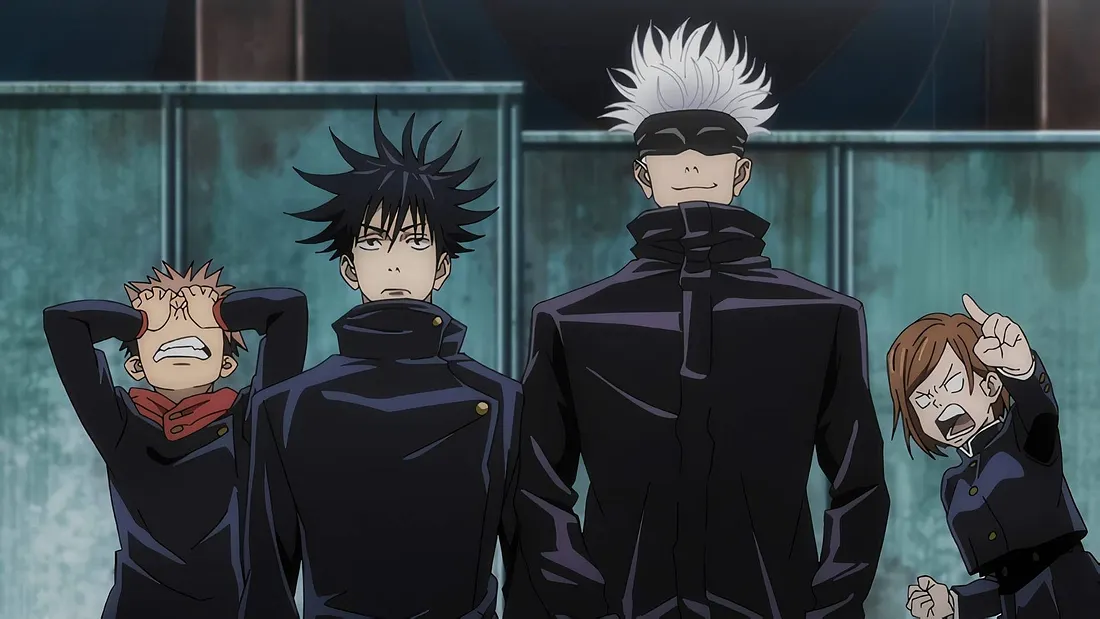
Image Credit — https://wallpapers.com/wallpapers/cute-first-years-jujutsu-kaisen-y25dcij0q6yw25oj.html
SPOILERS FOR JJK SEASON 1
Jujutsu Kaisen, when season 1 was released, was groundbreaking for many reasons, which made many people interested in the show and had slowly grown a creative and interactive fanbase that has now grown into one of the biggest anime fandoms. The show is about a young boy named Yuji Itadori who attends an occult club in a normal secondary school. This is until one day he comes across a dangerous object known as a cursed object hiding an antcient and dangerous monster named Sukana. He soon swallows the finger and starts to share a body with this monster.
This was a show I had found out had a big fandom through social media and within the anime community, so I was curious about watching it, but I was not disappointed by what I was met with on my watch of season 1. The art was very beautiful and not something I had seen a lot of. I got really connected with the characters and the complex world that the show portrayed, and yes, I was not a seasoned Shounen watcher, but from what I had heard, many people who had watched Shounen had found this a breath of fresh air.
The worldbuilding in anime can either be way too simple or way too complicated, and in some shows like JJK, it can easily go into being too complicated. However, in this case, the worldbuilding is explained in a way that is simple but also shows how complex the show can be. The worldbuilding helps connect different elements of the story, and this means that I didn’t experience many plotholes in the story and none that were so dramatic that they pulled me out of the story. There is also a clearly defined power level, which makes it easy to see where a character can grow skill-wise.
There is some complexity not only in how this world effects the sorcerers but also with the non-sorcerers as well, and how the curses stem from negative feelings, which is something that not only stems from Japanese stories but also from many supernatural hobbies and religions. Even though negative feelings and curse energy can be replaced with negative energy or negative spirits, it still doesn’t change the fact that the curses aspect had so much thought gone into it.
The characters are introduced in a way that highlights not only the slow progression of growth characters such as Yuji, Nobara, and Megumi, get but also creates an intriguing dilemma for the main character, which was something that added an interesting element that I hadn’t seen in many shounen. Yuji shares a body with a cursed spirit named Sukana, and not only that, but Sukana is shown and claimed to be the most powerful curse. This adds to the fact that Yuji doesn’t like the idea of hurting and killing people, which is what Sukana is all about.
The downside to the characters, however, and this being season 1, is that since the focus is set on the main three of Yuji, Nobara, and Megumi (not excluding Gojo as well), many characters fell to the side, and even though they gave a strong impression, I just wanted to see more of them. Nanami and the Kyoto class were a big example of this, since going more deeply into that section of the school within season 1 would’ve been an interesting look into how deep the world of JJK goes and how the curses affect wider Japan.
The story is a slow buildup into the second season; however, the main focus is not only Yuji learning how to use his powers with the help of Gojo but also the cast getting all of Sukanas fingers. There is a clear overall goal, but there is also an ongoing overall story that can impact the later seasons. With an ongoing story, many shows run into the issue of having a season 2 story shoved in at the end, which, on the good end, can add a nice bit of surprise, but on the bad end, it can make the story seem more messy.
The story gives balance to each of its plot elements in season 1 and constantly tests the characters in a way that slowly builds them up to who they are in the future. The main problem I have had with characters, especially with anime in the past, is making characters powerful from the start without that buildup and giving them enough tests to show this buildup. The thing with Yuji is that he is tested constantly, not only with his morality but also with his strength. An example is that he had to go from struggling to fight a low-level curse with a dagger to fighting a powerful curse even with the struggles.
Season 1 tonally is a lot lighter than the later season; however, this adds a nice start for people new to the series since it won’t put new viewers off by making the show too dark off the bat. There is a darker storyline with a character named Junpei. This is one of the first bigger emotional challenges for Yuji, who soon makes friends with Junpei, who ends up being manipulated by Mahito. After Junpae threatens his bullies and Yuji shows up to stop him, he is soon turned into a transfigured human, and this is a great way to start Yuji to question his morality while being a sorcerer.
The enemies show a contrast between what the protagonists think about the sorcerers wanting to protect humans and their own. Geto and his team are the opposite of this, where they want to get rid of non-sorcerers to protect curses and themselves. This goes on a deeper level, with Mahito taking joy in the murder that he does, with many scenes showing him laughing and mocking the people who he is killing, while Yuji is the opposite of this. Mahito is an interesting villain since he enjoys being evil with not much backstory or vulnerability to it.
In conclusion, this show has so many elements that I love about it, and it helps build up for later seasons very well. First season works really well to make sure that the audience understands who the characters are and their role in the story. The show avoids overcomplicating itself and makes sure that the power system is explained at the beginning and throughout the story without information dumping. Balancing the information given through the beautiful animation and story.
Comments
Post a Comment